TOXIC MARINE ORGANISMS IN MAURITIUS
Know Before You Eat and When in Doubt, Don’t Take the Risk.
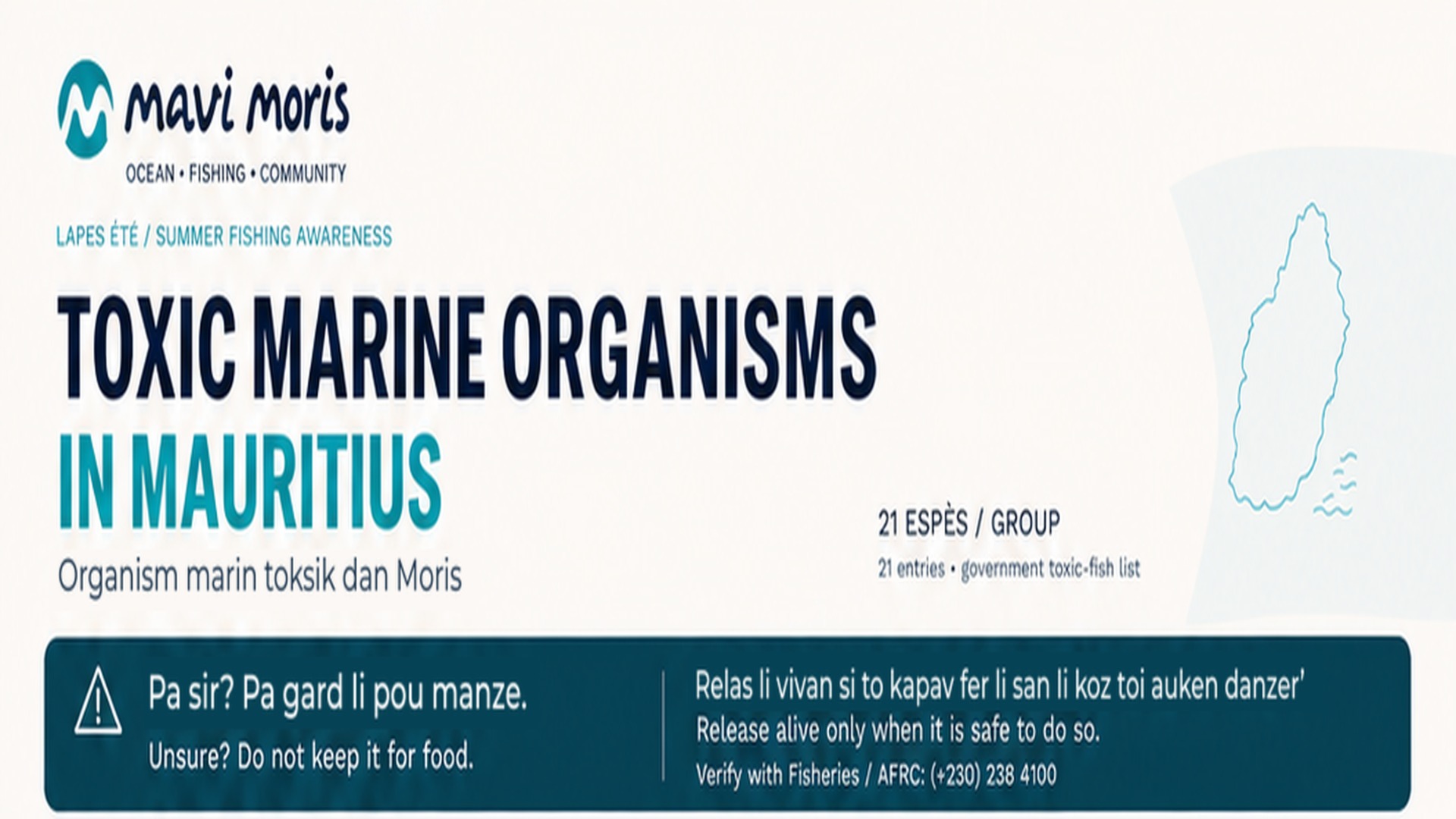
Summer fishing is part of life in Mauritius but our water also hold fish that carry ciguatoxin, a poison that even when cooking, frying and freezing cannot destroy. This guide is not here to scare you but it gives you clear, practical rules so you can keep fishing and eating safely. Read it, save it, share it.
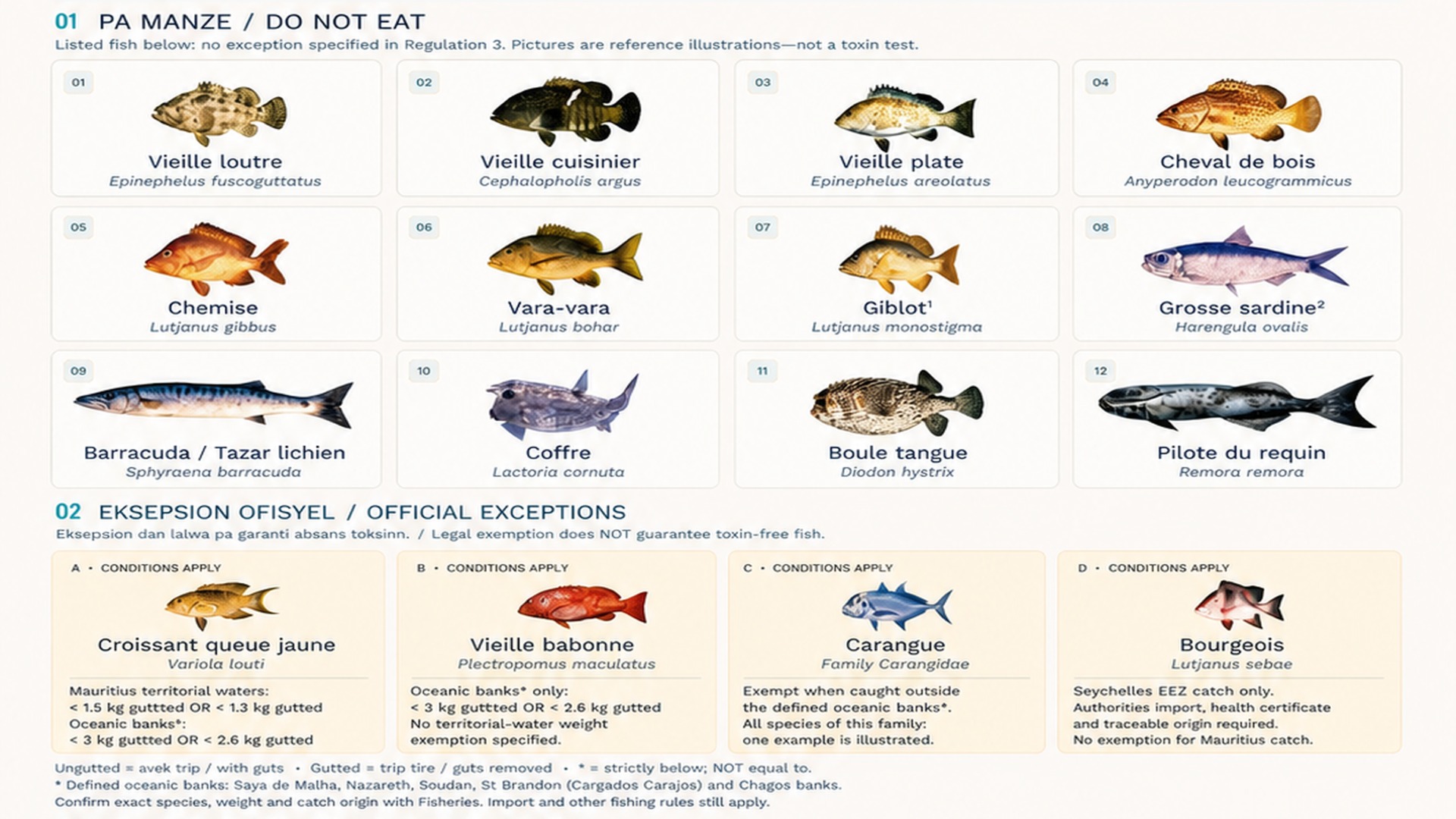
Section 01 lists 12 fish with no exception of any kind: Vieille loutre, Vieille cuisinier, Vieille plate, Cheval de bois, Chemise, Vara-vara, Giblot, Grosse sardine, Barracuda, Coffre, Boule tangue and Pilote du requin — size does not matter, catch location does not matter. It does not mean every single one of them is toxic every time; it means you cannot know, so you should not take the risk. Section 02 lists the only 4 official exceptions, each tied to strict conditions: Croissant queue jaune, Vieille babonne, Carangue and Bourgeois. Each has a weight limit (for example under 1.5 kg gutted for Croissant queue jaune in Mauritian territorial waters, under 3 kg gutted for Vieille babonne from the defined oceanic banks), and Carangue and Bourgeois come with conditions on where they are caught and the paperwork that must accompany them. Crucially, a legal exception does not mean the fish is toxin-free — confirm species, weight and catch origin with the Fisheries authorities before you rely on it.
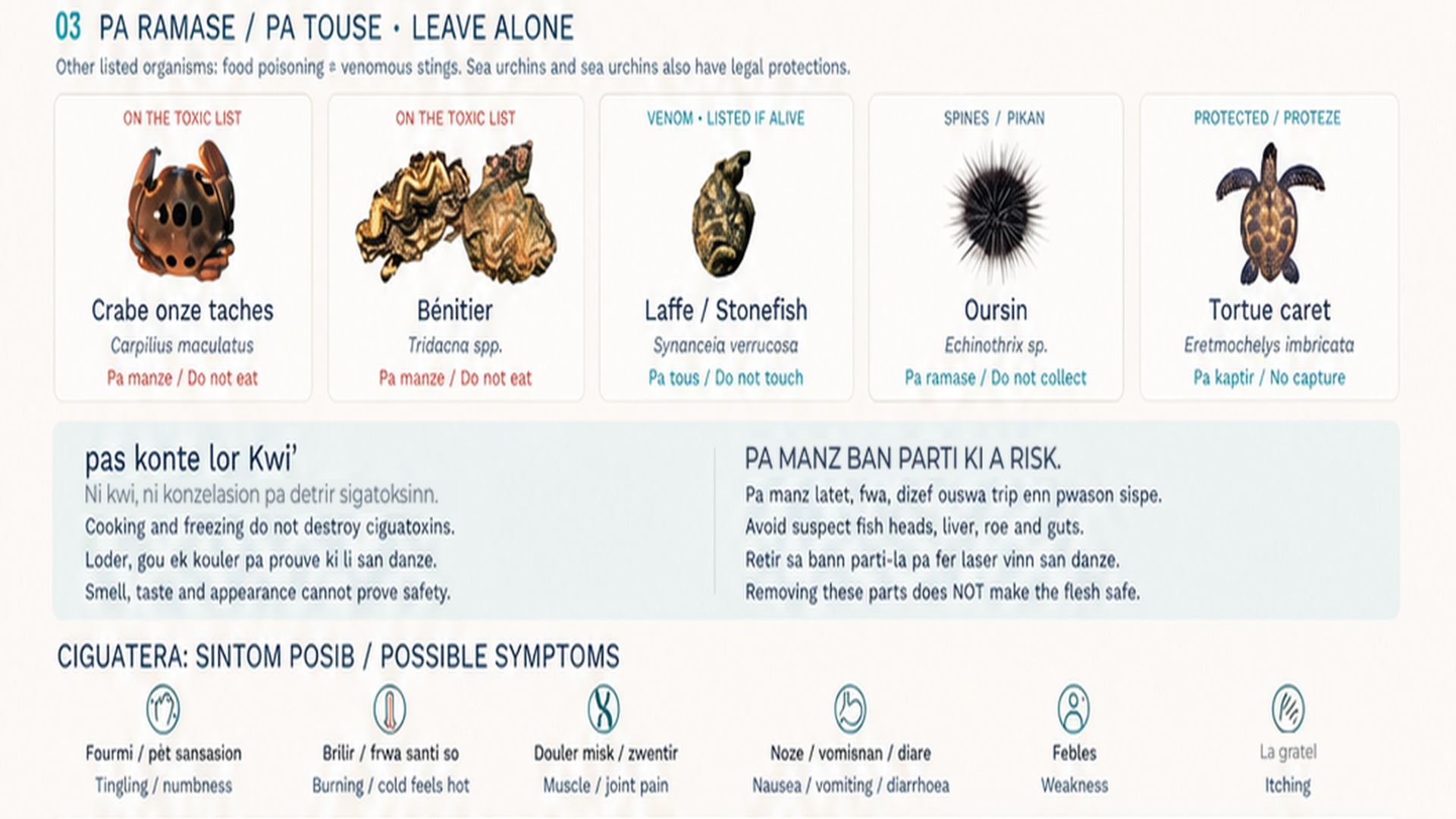
Section 03 covers everything else in the lagoon: Crabes onze taches and Bénitier are on the toxic list (do not eat); Laffe / Stonefish carries venomous spines and is listed if alive (do not touch); sea urchins have spines (do not collect); and hawksbill turtles are protected by law (no capture). The guide then destroys four dangerous beliefs: cooking and freezing do not destroy ciguatoxins; smell, taste and appearance cannot prove safety; removing the head, liver, roe and guts does not make the flesh safe; and eating "only the safe parts" is not a safe strategy. Finally, learn the symptoms: tingling or numbness, burning or cold-feels-hot, muscle and joint pain, nausea, vomiting or diarrhoea, weakness, and itching. If any appear after eating seafood or after a stonefish sting, seek medical care immediately — and if there is difficulty breathing, collapse or severe weakness, call 114 at once. Always verify with Fisheries / AFRC: (+230) 238 4100.